Blog · 2026-09-25
Where do you put the VIN on your tax return for the OBBBA car loan interest deduction?
Free VIN check · US assembly
Free VIN check — was it assembled in the US?
Paste the 17-character VIN. This reads NHTSA PlantCountry. It is a data check, not tax advice, and it does not decide whether any loan is deductible.
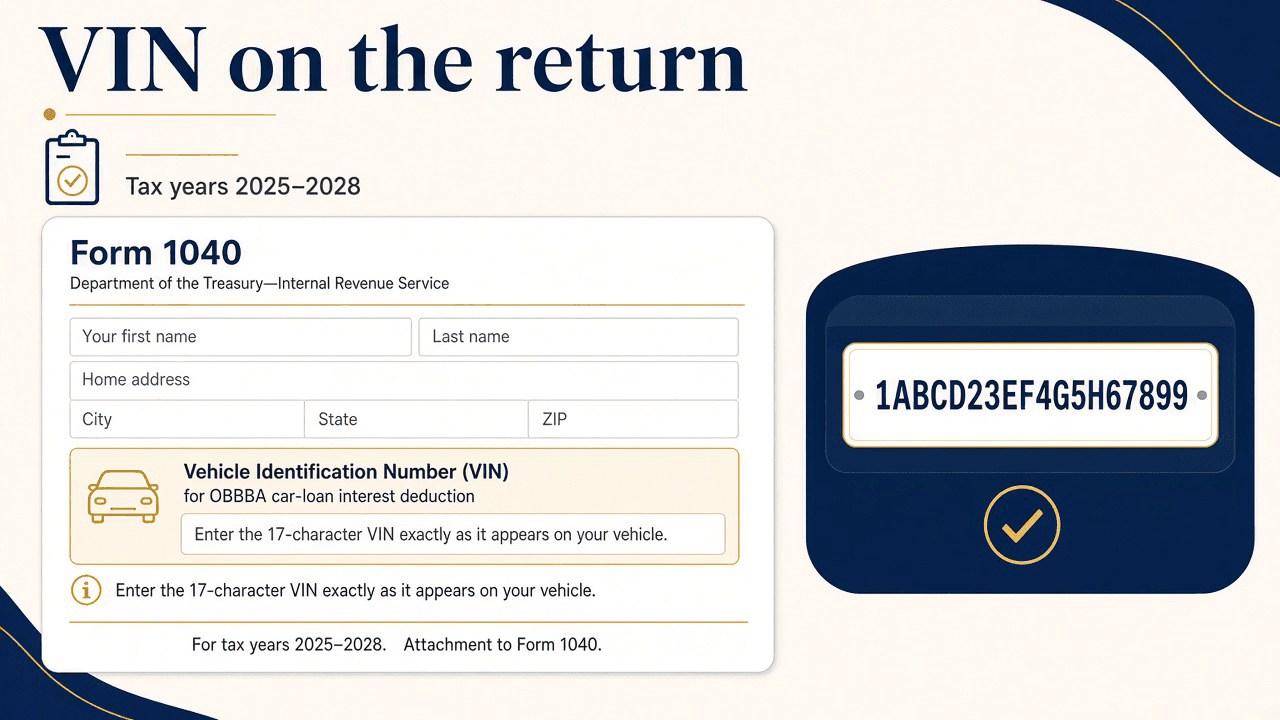
The VIN belongs on the return, not only in a glove box.
The IRS Working Families Tax Cuts pages say the taxpayer must include the vehicle identification number on the return for any year the qualified vehicle loan interest deduction is claimed. Topic no. 505 repeats the tax-year window and the United States final-assembly rule. Those pages describe a temporary deduction for tax years 2025 through 2028 for interest on a loan used to purchase a qualified vehicle, up to $10,000 of qualified interest a year, with a MAGI phaseout over $100,000 ($200,000 joint).
A VIN on the return is a reporting requirement. It is not proof of US assembly, MAGI clearance, original use, or that the interest is allowed. This page does not decide a return. AssemblyAlert never says a loan is deductible and never says a reader qualifies.
Check plant country now on the free homepage VIN checker. Paste the same 17-character VIN you would put on the return. AssemblyAlert reads NHTSA vPIC `PlantCountry`. It passes US assembly only if `PlantCountry` is exactly `UNITED STATES (USA)`. Puerto Rico is not a pass. VIN position 1 is a WMI screen, never the verdict. Plant-country Pass is not the deduction.
You can also paste that VIN in the free checker on this page.
Where the number goes — follow that year’s instructions
The IRS created Schedule 1-A in the Form 1040 family for these additional deductions, including the car-loan interest claim. The Schedule 1-A newsroom page says you report the VIN of the vehicle with that claim. The 2025 paper PDF shows VIN fields in Part IV.
Exact form and line placement follows that year’s IRS instructions and the software you use. Paper, e-file, and later-year layouts can move. Do not invent a line number from a blog post. Open the instructions and the form that match the tax year you are filing.
A VIN that stays in a folder at home is not the same as a VIN on the return. See the VIN on the return fact card and the tax-season documents list.
Match the dash plate before anyone files
Copy the 17 characters from the vehicle — dash plate or door jamb — not from a listing photo.
- Match that VIN to the loan closing packet.
- Match it to Form 1098-VLI if a lender furnishes one. See when 1098-VLI typically arrives.
- Run the same VIN through the free homepage VIN checker or the checker on this page.
If two documents disagree, stop. Do not invent a number to force a pass. Year / make / model text is not a substitute on the lines that want the VIN.
What a VIN on the return does not prove
Putting the number on Schedule 1-A — or whatever form that year uses — does not mean:
- Final assembly was in the United States
- MAGI cleared the phaseout
- Original use started with the taxpayer
- The interest is allowed
This site scores assembly only when `PlantCountry === UNITED STATES (USA)`. See Was my car assembled in the US?. Use the interest-cap estimator if you want to compare a dollar figure to the $10,000 cap. Use the 2025–2028 checklist as the gate list. Fact cards print the same IRS-stated lines.
Other IRS gates a filled VIN field does not rewrite
- Tax years 2025 through 2028
- Up to $10,000 of qualified interest
- MAGI phaseout over $100,000 ($200,000 joint)
- Loan originated after December 31, 2024
- Used to purchase a vehicle — lease payments do not qualify (Do auto leases qualify?)
- Original use starts with the taxpayer — used vehicles do not qualify (Do used cars qualify?)
- Personal use; lien; GVWR under 14,000 pounds
- US final assembly — Puerto Rico is not a pass. VIN position 1 is a WMI screen, never the verdict
- VIN on the return for any year the deduction is claimed
AssemblyAlert does not prepare returns and does not put a VIN on Form 1040.
FAQ
Where do I type the VIN?
On the return, for any year the deduction is claimed, in the place that year’s IRS instructions and software show — Schedule 1-A / Form 1040 family. Follow the current-year instructions.
Does a VIN on the return mean I qualify?
No. It is the identifier the claim asks for. This site never says a loan is deductible and never says a reader qualifies.
Can I describe the car instead?
Not on the lines that want the number. Copy the 17 characters from the vehicle.
Cite the IRS Working Families Tax Cuts pages. Confirm the vehicle, the loan, the statement, and the return with a preparer. Not tax advice. Not affiliated with the IRS or NHTSA. Owned by Record of Sale, LLC.
Calculators · Facts · Homepage VIN checker · Commercials (18+)