Blog · 2026-10-05
Plow, Belt, and Payload: The Working Life of the Willys CJ-2A and Its Go-Devil Four
Free VIN check · US assembly
Free VIN check — was it assembled in the US?
Paste the 17-character VIN. This reads NHTSA PlantCountry. It is a data check, not tax advice, and it does not decide whether any loan is deductible.
Assembly Alert. Published October 5, 2026. Every figure is tied to a source listed at the end. Where sources disagree, this article says so.
On July 17, 1945, Willys-Overland of Toledo, Ohio, put a civilian Jeep on sale. The ID tag said CJ-2A. The showroom name was the Universal Jeep, and Willys meant the word. It sold the little flat-fender as four machines in one: "Now it's a Truck... Now it's a Tractor... Now it's a Runabout... Now it's a Mobile Power Unit."
That pitch is the story. The CJ-2A was not built to be admired. It was built to be put to work, and Willys aimed it at a specific customer. By the company's own count, the United States had 5.5 million farmers, and more than 4 million of them had neither a truck nor a tractor. Willys called the CJ-2A "The All-Around Farm Work-Horse" and claimed it could do the job of two heavy draft horses at four miles an hour, ten hours a day, without overheating.
What follows is the CJ-2A told by the jobs it was sold to do, and how well it did them.
The Universal Jeep at a glance
| Willys-Overland CJ-2A "Universal" | |
|---|---|
| Built | 1945 to 1949 (Jeep). On sale July 17, 1945 (Hagerty) |
| Engine | Go-Devil L134, L-head (flathead) inline four, 134.2 cu in. Stellantis lists 2,195 cc (134 cu in) |
| Bore x stroke | 3.125 x 4.38 in |
| Compression | 6.48:1 |
| Power | 60 hp at 4,000 rpm gross; 54 hp at 3,800 rpm net |
| Torque | 105 lb-ft at 2,000 rpm |
| Gearbox | Warner T-90A three-speed, Spicer 18 two-speed transfer case |
| Axles | Dana 25 front, Dana 23-2 rear (Stellantis); 5.38:1 ratio (1945) |
| Wheelbase | 80 in |
| Weight | 2,215 lb curb; 3,500 lb gross vehicle weight |
| Governor | Engine speed held from 1,000 to 2,600 rpm, set from the dash |
| Price | $1,090 MSRP in 1945 (Jeep); $1,241 MSRP in 1946 (Farm Collector) |
| Production | 1,824 built for 1945 (MotorTrend); nearly 215,000 in all (Hemmings) |
| 1945 colors | Harvest Tan and Pasture Green |
Sources vary on output. MotorTrend and Hagerty give the CJ-2A's Go-Devil 60 gross horsepower; Farm Collector lists 63 hp for the 1946 model. This article uses 60.
The tryout before the job
The farm idea started in the middle of the war. In the spring of 1942, the U.S. Department of Agriculture got two military jeeps, one from the War Department and one from Willys-Overland, and sent them to the Farm Tillage Machinery Laboratory in Auburn, Alabama. That lab, now the USDA's National Soil Dynamics Laboratory, was the world's first full-size laboratory for tillage and traction research, according to the American Society of Mechanical Engineers.
Hemmings reports the jeeps were hitched to plows, cultivators, mowing machines, harrows, and lime spreaders. The verdict was honest. A jeep could not match a tractor for row-crop work. It sat too low, its track width could not be adjusted to straddle growing rows, and it burned more fuel. The testers still saw plenty for it to do: carry farmhands to the fields, round up cattle, tow trailers, work as a stationary power unit, and reach places conventional trucks and cars could not. With lower gearing, a governor, and a hitch, they thought it could handle light fieldwork.
Willys was watching. The civilian Jeep it built answered almost every note: deeper axle and transfer case gearing so it could crawl, a tailgate, provisions for hitches, a power take-off, and a governor, per Hemmings. MotorTrend's Jeep Encyclopedia says the CJ-2A debuted in June 1945, and only 1,824 of the 1945 models were built before the 1946 models were announced that October.
Job one: plowing
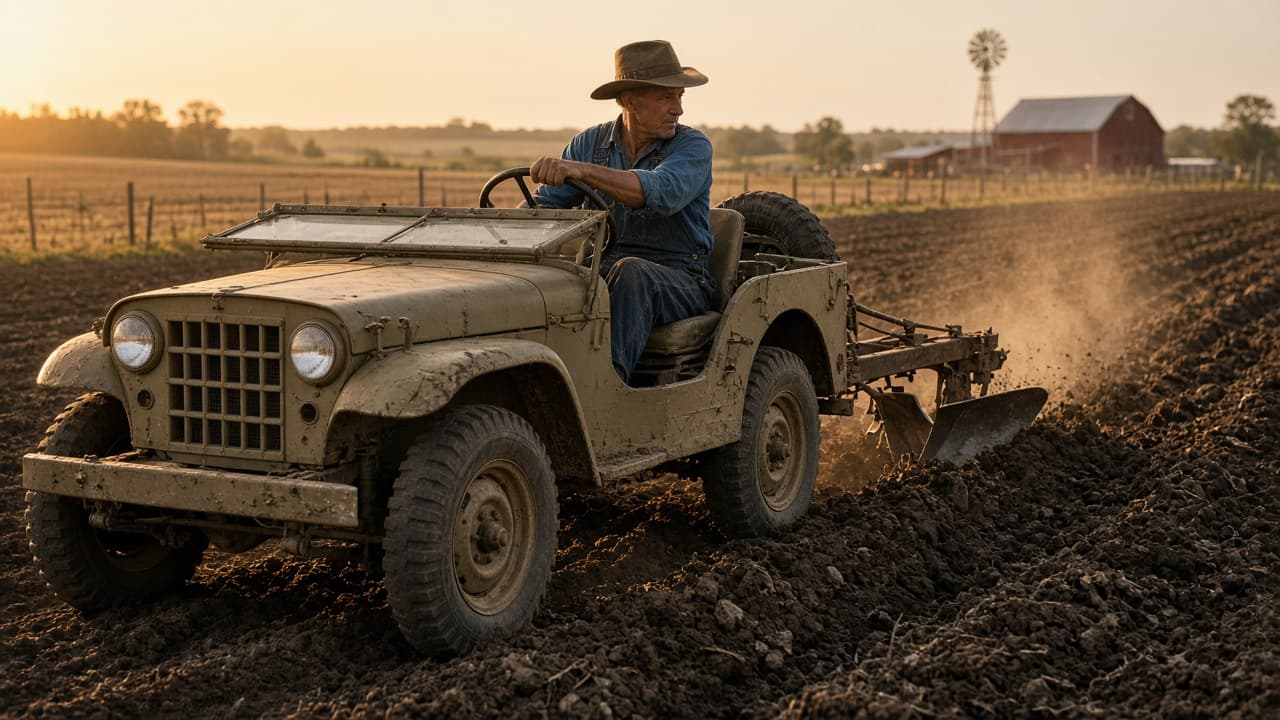
Plowing was the headline job, and it was the hardest one to fake. A light vehicle with a plow behind it wants to lift its nose. Farm Collector reports Willys answered with a 265-pound weight mounted between the frame rails behind the front bumper, there to hold the front end down while plowing.
The hitch made the plow possible. Farm Collector notes that the Monroe Co. built a three-point hitch with hydraulic lift for the Jeep, and that the Newgren Co. of Hillsdale, Michigan, built a mounted two-bottom plow. "Jeep Approved" hydraulic lifts, installed at the factory or by a dealer, used standard three-point implements, the same system Ford had introduced in 1939 with the 9N tractor. After the war, as Farm Collector puts it, a farmer who wanted a three-point tractor could buy a Ford, a Ferguson, or a Jeep.
Gearing did the rest. Jeep's history says the CJ-2A got revised transmission and transfer case ratios that allowed low-speed hauling while still reaching highway speeds as high as 60 mph, along with a beefier clutch and better cooling. MotorTrend lists 5.38:1 axles on the 1945 models.
Job two: harrowing, cultivating, and harvest
Behind the plow came the lighter field work, and here the photo record is generous. A National WWII Museum photograph dated September 6, 1945, shows the "newly-designed postwar jeep" hauling a spring tooth cultivator, with an official caption calling it "but one of the many farm uses for which the Jeep is admirably suited." At a "Jeep Day" on July 18, 1945, at the Cesor Farm in New Hudson, Michigan, a Jeep pulled a reaper to show it could harvest, according to the Toledo Lucas County Public Library's Jeep history collection.
Hemmings describes Willys ads of the period showing Jeeps "pulling disc harrows" and powering post-hole diggers. Farm Collector adds trail-type spring-tooth and spike-tooth harrows, mounted discs, sickle bar mowers, and photographs of Jeeps running corn binders, one-row corn pickers, balers, and combines.
The 1942 test had already found the limit. Towing a six-foot tandem disc harrow for six and a half hours, Hemmings reports, the test jeep used 50 percent more fuel than a comparable tractor. A gasoline tractor might turn 1,300 rpm under load; the Go-Devil needed 2,000 or more. Farm Collector adds that offset cultivators were impractical because the Jeep lacked the clearance to keep cultivating corn as it grew.
Job three: the power take-off and the belt
This is where the CJ-2A earned its keep. Farm Collector's verdict is blunt: the best use for the Farm Jeep was as a mobile power unit, and owners used it to run feed grinders, buzz saws, generators, sprayers, balers, combines, and other PTO-powered equipment. Farm Collector also notes the Jeep could supply power through the PTO for both belt and shaft work.
Willys advertised the CJ-2A as "A Powerhouse on Wheels." Jeep's history describes a variety of farm implements and industrial tools devised to work with an onboard power take-off unit, and a belt-driven governor controlled from the instrument panel that held engine speed anywhere from 1,000 to 2,600 rpm. That matters for belt work. A buzz saw or a feed grinder wants a steady speed whether the log is thin or thick, and the governor was there to hold it. Hemmings notes that Willys ads showed Jeeps dragging logs to sawmills, which, as Hemmings puts it, "could also be powered by Jeeps."
The governor range brackets the engine's torque peak. The Go-Devil made its 105 lb-ft at 2,000 rpm, near the middle of the 1,000 to 2,600 rpm band the governor could hold.
Job four: towing and hauling
On the road, the CJ-2A was the farm's pickup. In Hagerty's summary of the Willys pitch, a Jeep could haul up to 800 pounds. Willys also claimed, as quoted by Farm Collector, that the Jeep could "pull a 5,500-pound load on the highway at a good speed." That is a Willys marketing claim, not a tested rating, and it is printed here as Willys' claim.
Hemmings lists hauling milk cans among the jobs in the ads. The 1942 testers had already pointed to towing trailers and moving farmhands. A tailgate, which the military jeep never had, made loading easier, and with an added back seat, Farm Collector observes, the same machine could take the family to church in any weather.
Job five: fleet, shop, and small-business work
Willys did not stop at the farm gate. Hagerty notes that the company pitched the CJ-2A as a machine that could power an air compressor, haul a load, pull a plow or a mower, or reach a remote campsite, and advertised to farmers in Farm Journal. Jeep's history says Popular Science offered cash awards for "Ideas on Peacetime Jobs for Jeeps," and that Jeeps soon became the platform for hundreds of applications. One lasted: from 1949 to 1964, either a complete Jeep vehicle or a Jeep chassis was used on every Zamboni ice resurfacing machine, per Jeep.
The accessory catalog grew to match. MotorTrend reports the 1948 Willys-Overland accessory book ran 120 pages of factory-authorized equipment. One entry was the MAHL Model JA front loader, listed at $343 without a bucket and rated for 1,100 pounds. Only about 300 were sold, and MotorTrend's Jim Allen gives the reason plainly: purpose-built equipment generally did a better job than a converted Jeep.
That is the honest ledger on the Universal Jeep. It could not put a Farmall out to pasture, as Hemmings notes. What Willys never predicted, by Hemmings' account, was that civilians would flock to Jeeps because they were plain fun as well as useful.
The engine behind every job
The Go-Devil was older than the Jeep. MotorTrend traces it to the Willys four of the 1926 Whippet, which displaced the same 134.2 cubic inches but made 30 hp. When Willys hired Delmar G. "Barney" Roos as chief engineer in 1938, his reliability benchmark was 100 hours at full power. The old four lasted 22 hours on the dyno at 3,400 rpm. Roos and his staff added insert bearings, a fully counterbalanced crankshaft, aluminum pistons, full pressure lubrication, and a revised valvetrain, and the reworked engine ran more than 100 hours at over 60 hp.
In the CJ-2A it is an L-head, or flathead, four with the valves in the block: 3.125 by 4.38 inches, 6.48:1 compression, 60 hp at 4,000 rpm gross, 54 hp net at 3,800, and 105 lb-ft at 2,000 rpm. MotorTrend puts the bare engine at 365 pounds. It went on to power Jeep wagons and trucks and was also sold as a commercial, marine, and stationary generator engine, a fitting second career for a motor built to run all day.
Where the work went
Hemmings reports nearly 215,000 CJ-2As were built before the CJ-3A replaced it in 1949. Jeep's history dates the CJ-3A's introduction to late 1948, with a one-piece windshield and a stronger rear axle, and Stellantis notes it kept the L-head four. Willys-Overland itself is gone. Stellantis' history says Kaiser bought the company in 1953 for $60 million; American Motors later owned Jeep, and Chrysler acquired AMC in 1987. The Jeep brand now belongs to Stellantis, which builds the Wrangler and Gladiator at its Toledo Assembly Complex in Ohio.
Check the plant on a modern Jeep, or anything else
A 1940s CJ-2A predates the modern VIN. Federal rules required a 17-character, fixed-format VIN starting with the 1981 model year, so a Universal Jeep's serial plate will not run through a modern decoder, and it would not qualify for today's car-loan deduction anyway.
For a modern vehicle, run the 17-character VIN through the free checker at https://assemblyalert.com. You can also paste the VIN in the free checker on this page. The report shows the plant country of final assembly. That is the fact that matters for the car-loan interest deduction in the One Big Beautiful Bill Act. The VIN's first digit is not the verdict. Per IRS Topic 505, for tax years 2025 through 2028 the deduction covers up to $10,000 a year of qualified interest on a loan taken out after December 31, 2024, secured by a first lien on the vehicle; the vehicle's original use must start with the taxpayer, so used vehicles do not qualify, and its final assembly must be in the United States. Income limits apply. Read the full rules at IRS Topic 505. This is not tax advice.
FAQ
Was the Willys CJ-2A a tractor?
Willys marketed it for four jobs: truck, tractor, runabout, and mobile power unit. With a hitch, lift, and governor it plowed and pulled harrows, but USDA's 1942 tests and later experience found it could not match a tractor for row-crop work or fuel use. Farm Collector calls its best use a mobile power unit.
How much power did the CJ-2A's Go-Devil engine make?
MotorTrend lists 60 hp at 4,000 rpm gross and 105 lb-ft at 2,000 rpm, from 134.2 cubic inches at 6.48:1 compression. Farm Collector cites 63 hp for the 1946 model.
What did a CJ-2A cost new?
Jeep lists a 1945 MSRP of $1,090. Farm Collector reports $1,241 for 1946.
How many CJ-2As were built?
Hemmings says nearly 215,000 were built from 1945 to 1949. MotorTrend says only 1,824 of those were 1945 models.
Can I check a CJ-2A with a VIN checker?
No. The 17-character VIN format began with the 1981 model year. Modern VIN checkers, including the free one at assemblyalert.com, are built for that format.
Sources
- Jeep, 1940-1949 history
- Stellantis Media, Jeep History
- Stellantis Media, Toledo Assembly Complex fact sheet
- Hemmings, "Peace Jeep: The 1946-49 Willys CJ2-A," Mike McNessor
- MotorTrend, "1945 CJ-2A - Jeep Encyclopedia," Jim Allen
- MotorTrend, "The Willys Go-Devil Engine - Jeep Encyclopedia," Jim Allen
- MotorTrend, "The Holy Grail of Jeep Industrial Accessories," Jim Allen
- Hagerty, "Happy Veterans Day to the Willys-Overland Jeep"
- Farm Collector, "The Willys-Overland Farm Jeep," Darrell Wrider
- Farm Collector, "Changes Put Farm Jeeps to Work," Barry Thomas
- The National WWII Museum Digital Collections, photograph, September 6, 1945
- Toledo Lucas County Public Library, "Jeep: It's a Toledo Thing," Cesor Farm demonstration, 1945
- ASME, National Soil Dynamics Laboratory landmark
- Federal Register, Vehicle Identification Number Requirements (April 30, 2008)
- IRS, Topic no. 505, Interest expense
The images in this article are illustrations made for Assembly Alert. They show an unbadged vehicle and are not photographs of a CJ-2A.
Calculators · Facts · Homepage VIN checker · Commercials (18+)