Blog · 2026-10-05
Buying a Used Ford F-150 Lightning: What to Check Before You Pay
Free VIN check · US assembly
Free VIN check — was it assembled in the US?
Paste the 17-character VIN. This reads NHTSA PlantCountry. It is a data check, not tax advice, and it does not decide whether any loan is deductible.
Assembly Alert. Published October 5, 2026. Every figure is tied to a source listed at the end. Recall data was pulled from NHTSA on October 5, 2026.
Ford took America's best-selling truck, pulled the engine, and put a lockable trunk where the V8 used to live. Full production of the F-150 Lightning began on April 26, 2022, at the Rouge Electric Vehicle Center in Dearborn, Michigan, inside the historic Rouge complex that Executive Chair Bill Ford called the place where Ford "perfected the moving assembly line." The electric motors came from Ford's Van Dyke Electric Powertrain Center and the batteries were assembled at its Rawsonville Components Plant, both in Michigan.
That chapter is closed. On December 15, 2025, Ford said production of the current-generation Lightning "has concluded." The next Lightning will be a generator-backed extended-range electric truck, also built at the Rouge Electric Vehicle Center, with no on-sale date announced. For current owners, Ford says its support "remains fully unchanged," including over-the-air software updates and replacement parts.
That makes the all-electric Lightning a used-truck story. Here is what to check before money changes hands.
Know which Lightning you are looking at
Every first-generation Lightning is a crew cab with a 5.5-foot bed, two electric motors, and all-wheel drive. The big decision is the battery.
| Standard Range | Extended Range | |
|---|---|---|
| Usable battery | 98 kWh | 131 kWh (Ford also lists a 123 kWh extended pack for 2025) |
| Peak output | 452 hp, 775 lb-ft | 580 hp, 775 lb-ft |
| EPA range | 230 miles (2022); 240 miles (2023-2025) | 320 miles; 300 miles for Platinum |
| Max towing | 7,700 lb | 10,000 lb with the Max Trailer Tow package |
For 2025, the EPA rates two extended-range versions at 320 and 300 miles, and Ford says capacity "varies by model and year," so confirm the exact pack. On 2023 models, Ford's VIN guide filed with NHTSA uses the eighth character: "L" for the standard-range battery, "V" for extended range.
Trims run from the work-truck Pro through XLT, Lariat, and Platinum. At launch, Ford offered the extended-range battery on the Pro to fleet customers. For 2024, Ford added the Flash, an XLT-based truck with the extended-range battery, a 15.5-inch touchscreen, and a heat pump. The Lightning launched at a starting price under $40,000; Ford's 2024 order prices listed a standard-range Pro at $49,995 and a Platinum at $89,995.
Pull the recall history before anything else
As of October 5, 2026, NHTSA lists 15 recall campaigns filed under F-150 Lightning model names for the 2022 through 2026 model years. Several are second rounds for trucks repaired incorrectly the first time, so "the recall was done" is not the end of the conversation. In plain English:
- Battery fire risk (23V-168, 2023 trucks). On February 4, 2023, a Lightning caught fire on a Ford holding lot while charging during a pre-delivery check, and production stopped the next day. Ford traced it to a supplier's cell defect, recalled 18 trucks for new battery packs, and restarted production March 13, 2023.
- Battery cell short circuit (25V-131, 2022-2024). A cell defect may cause an internal short and a fire risk. Until the repair is done, Ford's advice is to charge to no more than 80 percent. Dealers inspect and replace the battery array as needed.
- Battery junction box (24V-144 and its expansion, 25V-272). Loose bus bar fasteners inside the battery pack can arc, raising fire risk and possibly causing a loss of drive power.
- Front suspension (24V-949 for 2023-2024, 25V-341 for 2024-2025). A front upper control arm ball joint nut may not have been tightened properly, and the arm can detach.
- Park lock (25V-863, 2022-2026). The park module may fail to lock into Park, so the truck could roll away. The fix is a software update, over the air or at a dealer.
- Brakes (25V-438, 2025). Front brake hose bracket screws may loosen, letting the hose contact the tire and leak fluid.
- Stability control (23V-801, then 25V-313). Software may fail to switch electronic stability control back on at each start.
- Tire pressure warning (22V-453, then 25V-340, 2022). On trucks with 20- or 22-inch all-season tires, the system was set to 35 psi instead of 42 psi, so the low-pressure light came on late.
- Reverse lights (23V-418, then 25V-731). Microcracks in the rear light bar can let in moisture and make the reverse lights flicker or quit.
- Defroster (23V-688, 2023). A cabin coolant heater module may be missing a solder joint, which can cost you cabin heat and the windshield defroster.
All of these remedies are free. To check a specific truck, enter its 17-character VIN at nhtsa.gov/recalls, or call Ford at 1-866-436-7332, the number listed on these NHTSA recall records. Some broader Ford recalls are filed under plain "F-150," so the VIN lookup is the final word. Ask the seller for dealer paperwork showing each campaign closed, especially the battery ones.
Battery and charging checks
The range readout is not a battery test. Ford says Intelligent Range draws on past driver behavior, weather, speed, terrain, towing, and payload, so a low number may say more about the last owner's driving than the pack. Ford's warranty leaves formal capacity measurement to EV Certified Ford dealers, so ask there.
Plug it in. Try a Level 2 charger and, if you can, a DC fast charger. Ford says the Lightning fast-charges from 15 to 80 percent in 44 minutes, and that extended-range trucks, with dual onboard chargers and the 80-amp Ford Charge Station Pro, can fully charge overnight.
Ask what charging gear comes with it. Extended-range buyers got the Charge Station Pro at no extra cost. Ford says it is no longer for sale, and automatic home backup power needs it plus a Sunrun Home Integration System. Standard-range trucks also need a one-time $500 activation for that feature, which Ford says stays with the truck when sold. Ask, too, about the Tesla Supercharger adapter: free if reserved by June 30, 2024, then $230.
Test the outlets. Pro Power Onboard is standard at 2.4 kW; the optional 9.6 kW system adds a 240-volt outlet and came standard on the Platinum. Outlets sit in the cab, the bed, and the front trunk, which has four outlets and two USB chargers. Bring a drill and try each one. It is the only test drive where the truck runs your tools.
Warranty: find out what is left
Ford's coverage on the Lightning runs 3 years or 36,000 miles bumper to bumper and 5 years or 60,000 miles on the powertrain. The Electric Vehicle Component coverage lasts 8 years or 100,000 miles, whichever comes first. It covers the high-voltage battery, the onboard charger, the inverter, the DC/DC converter, and the eDrive. It also covers the battery if a dealer finds its capacity below 70 percent of where it started. Ford's warranty guide says a buyer of a previously owned Lightning gets any coverage that remains.
The clock starts when the first owner took delivery or the truck went into service, such as a dealer demo, whichever came first. A truck first delivered in mid-2022 has battery coverage until mid-2030 or 100,000 miles, whichever comes first. Ask a Ford dealer to confirm the start date for the VIN.
Towing and range: the honest numbers
The Lightning does real truck work. Ford rates it to tow up to 10,000 pounds with the extended-range battery and Max Trailer Tow package, and Ford says it can carry up to 2,235 pounds of payload when properly equipped. Its front trunk holds 400 liters of cargo and up to 400 pounds, according to Ford and Car and Driver.
Range is the catch. Car and Driver hitched an extended-range Lightning Platinum to a 6,100-pound, 29-foot camper at 70 mph, and a full battery got about 100 miles. Unhitched, in its 75-mph highway test, the truck went 230 miles. The Lightning is a strong local hauler and a slow long-distance tower. Buy it for the job you actually do.
Check the plant on the VIN
Ford's support page says the Lightning was "proudly assembled in the United States out of domestic and globally sourced parts," at a plant built specifically for it. In Ford's VIN guide for 2023 models, the 11th character "W" stands for "Rouge Electric: Dearborn, Michigan."
Run any VIN through the free checker at https://assemblyalert.com. You can also paste the VIN in the free checker on this page. The report shows the plant country of final assembly, which is what matters for the car-loan interest deduction in the One Big Beautiful Bill Act. The VIN's first digit is not the verdict. One honest catch for this guide: per IRS Topic 505, the vehicle's original use must start with the taxpayer, and used vehicles do not qualify. We explain that rule in Do used cars qualify for the OBBBA car loan interest deduction? This is not tax advice.
FAQ
Is Ford still building the all-electric F-150 Lightning?
No. Ford said on December 15, 2025, that production of the current generation had concluded. The next Lightning will be an extended-range EV built at the Rouge Electric Vehicle Center. Ford says software updates and parts continue for current owners.
How do I tell a standard-range Lightning from an extended-range one?
Ask for the window sticker or dealer build data. On 2023 models, the VIN's eighth character is "L" for standard range and "V" for extended range, per Ford's VIN guide.
Does the battery warranty transfer to a used buyer?
Yes. Ford says a buyer of a previously owned Lightning gets any remaining coverage. Electric Vehicle Component coverage runs 8 years or 100,000 miles from the original warranty start date.
How do I check a used Lightning for open recalls?
Enter the VIN at nhtsa.gov/recalls or call Ford at 1-866-436-7332. NHTSA lists 15 Lightning campaigns for model years 2022 through 2026.
Does a used Lightning qualify for the car-loan interest deduction?
Per IRS Topic 505, used vehicles do not qualify, because the vehicle's original use must start with the taxpayer. This is not tax advice.
Sources
- Ford Motor Company, news release, December 15, 2025, filed with the SEC as Exhibit 99
- Ford.com, F-150 Lightning specs and owner support page
- Ford.com, F-150 Lightning General Product Information
- Ford.com, What is Ford Home Backup Power?
- Ford, From the Road, "Introducing the F-150 Lightning Flash"
- Ford news release, May 11, 2022, "Power Moves: F-150 Lightning Delivers More Horsepower, More Payload Capacity, More Range" (Ford of Europe press copy)
- Ford news release, April 26, 2022, production begins (distributor repost)
- Ford, 2023 Model Year Battery Electric Vehicle Warranty Guide
- Ford, 2023 model-year VIN guide filed with NHTSA
- NHTSA recalls API, 2022-2026 F-150 Lightning
- NHTSA, Part 573 report, recall 23V-168
- NHTSA, chronology, recall 23V-168
- EPA and DOE, fueleconomy.gov, 2022 F-150 Lightning
- Car and Driver, "Tested: How Towing Affects Electric Pickups," Dave VanderWerp
- Car and Driver, 2025 Ford F-150 Lightning review
- Reuters, "Ford juices production of Lightning F-150 electric truck to meet demand," April 26, 2022
- CNBC, "Ford rolls out Tesla Supercharging for EVs," February 29, 2024
- IRS, Topic no. 505, Interest expense
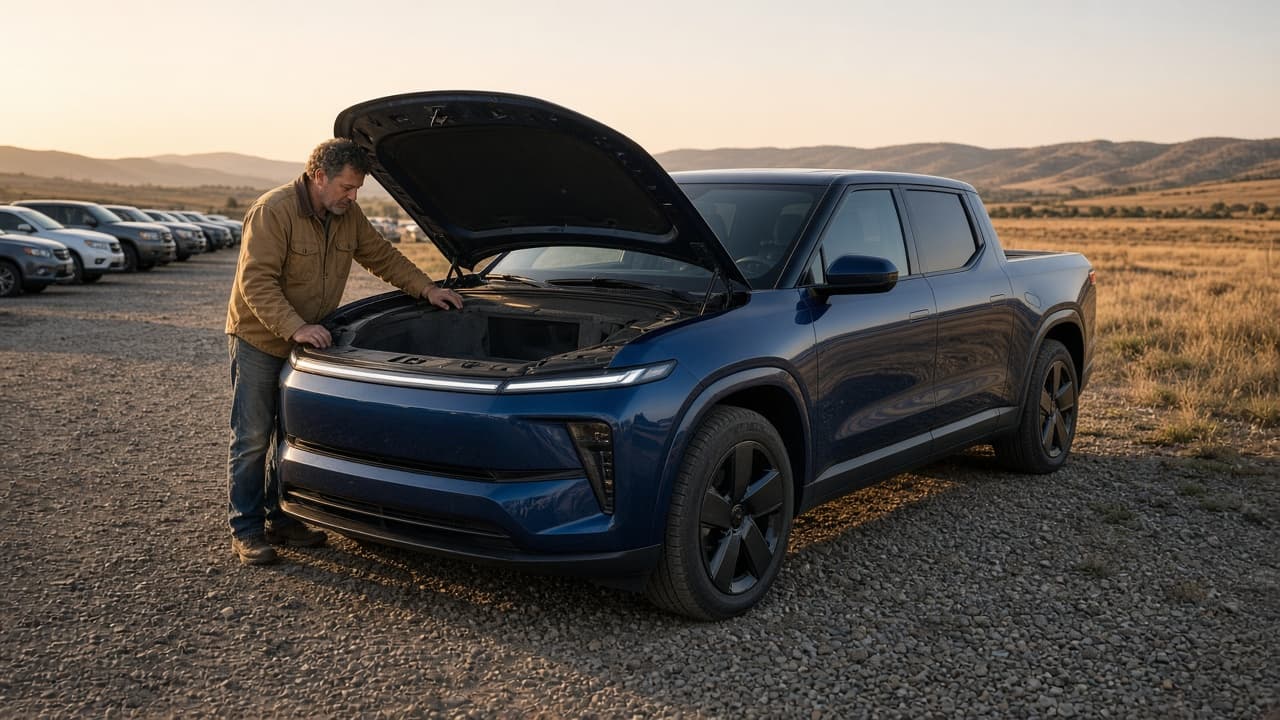
The images in this article are illustrations made for Assembly Alert. They show an unbadged vehicle and are not photographs of an F-150 Lightning.
Calculators · Facts · Homepage VIN checker · Commercials (18+)