Blog · 2026-10-05
29 Records on Pump Gas: The Supercharged Studebaker Avanti That Took Bonneville
Free VIN check · US assembly
Free VIN check — was it assembled in the US?
Paste the 17-character VIN. This reads NHTSA PlantCountry. It is a data check, not tax advice, and it does not decide whether any loan is deductible.
Assembly Alert. Published October 5, 2026. Every figure is tied to a source listed at the end.
Studebaker had a new car, very little money, and less time. So it went to the salt.
In August 1962, Andy Granatelli drove a supercharged Studebaker Avanti across Utah's Bonneville Salt Flats and came back with 29 American stock-car records, sanctioned by the United States Auto Club. The best known is a flying mile at 168.15 mph. That was a two-way average, not a single hot pass, and USAC certified the car as stock and running on Mobil premium pump gas. The old American Class C mark, held by a Dodge, fell by more than 50 mph.
For a company that started as a South Bend, Indiana, wagon shop in 1852, those numbers were more than bragging rights. They were the ad campaign.
The runs, by the numbers
| When | Driver and car | Record or run | Speed |
|---|---|---|---|
| Aug. 1962 | Andy Granatelli, supercharged Avanti | Flying mile, two-way average (one of 29 USAC records) | 168.15 mph |
| Aug. 1962 | Granatelli | Flying 5 miles, two-way average | 167.82 mph |
| Aug. 1962 | Granatelli | Flying 10 miles, two-way average | 163.90 mph |
| Aug. 1962 | Granatelli | Return leg of the 20-mile run (one way) | 178.5 mph |
| Oct. 1963 | Paula Murphy, production-model Avanti | Flying mile, two-way average | 161.29 mph |
| Oct. 1963 | Granatelli, R3 Avanti "No. 9" | Class C records, 1 kilometer to 10 miles | 170.8 mph |
| Oct. 1963 | Granatelli, experimental twin-supercharged "Due Cento" | Top run, not a production-car record | about 196 mph |
Classic Motorsports, which reported the 1962 figures, describes the record car as an R-3. That engine reached Studebaker's order sheet only for 1964.
Why a car company went to the salt
Studebaker had lost money in every year but one from 1953 through 1960, according to the Studebaker National Museum. Its board brought in a new president, Sherwood Egbert, on February 1, 1961. Egbert wanted a radical new car, and fast. He hired Raymond Loewy, whose team worked in secret near Palm Springs, California. The Avanti debuted at the New York Auto Show on April 25, 1962, about 14 months later. The museum notes that new cars usually took three to five years.
It was built from what South Bend had on the shelf. Underneath was a reinforced Lark convertible frame on a 109-inch wheelbase, wearing a fiberglass body. Power came from the Hawk's 289 V8, and the car stopped on caliper front disc brakes. Studebaker called it "America's Most Advanced Car." It still needed proof that it was fast.
That job went to Paxton Products, the supercharger maker Studebaker bought in March 1962. Paxton's president was Andy Granatelli, a Chicago hot-rodder who would go on to win the Indianapolis 500 as a car owner in 1969. By the fall of 1962, Studebaker was advertising the Avanti as "The World's Fastest Production Car."
Granatelli also sold the handling. In a letter to Egbert, he wrote: "I took four people [including the L.A. Times auto editor] for a ride at speeds from 166.6 to 172.5 mph, and in each instance I let go of the steering wheel for several thousand feet to prove how stable the Avanti really is."
The motors: R1, R2 and R3
All three grew from Studebaker's 289-cubic-inch overhead-valve V8, which Studebaker called the "Jet-Thrust."
- R1. Normally aspirated, with a Carter four-barrel, 10.25:1 compression, and a 260-degree camshaft. Rated at 240 hp.
- R2. The same 289 with a belt-driven Paxton SN-60 centrifugal supercharger blowing 4.5 pounds of boost, and compression cut to 9.0:1. It made 289 hp, one horsepower per cubic inch. Road & Track timed an R2 from zero to 60 mph in 7.3 seconds.
- R3. The Granatelli brothers bored the cylinders out 0.093 inch, keeping the 3.625-inch stroke, for 304.5 cubic inches. That was just under the 305-cubic-inch limit some sanctioning bodies used. It got bigger valves, 9.75:1 compression, and 6 pounds of Paxton boost into a 650-cfm Carter four-barrel. Studebaker never really announced its output. Hemmings puts "factory" trim at 335 hp and 320 lb-ft. Only nine Avantis left South Bend with an R3.
The 1963 return
Granatelli went back in October 1963 with a dozen Studebakers, his brothers Joe and Vince, drivers Paula Murphy and Barbara Nieland, and a crew of 20. The cars ranged from an economy six-cylinder to the experimental Due Cento.
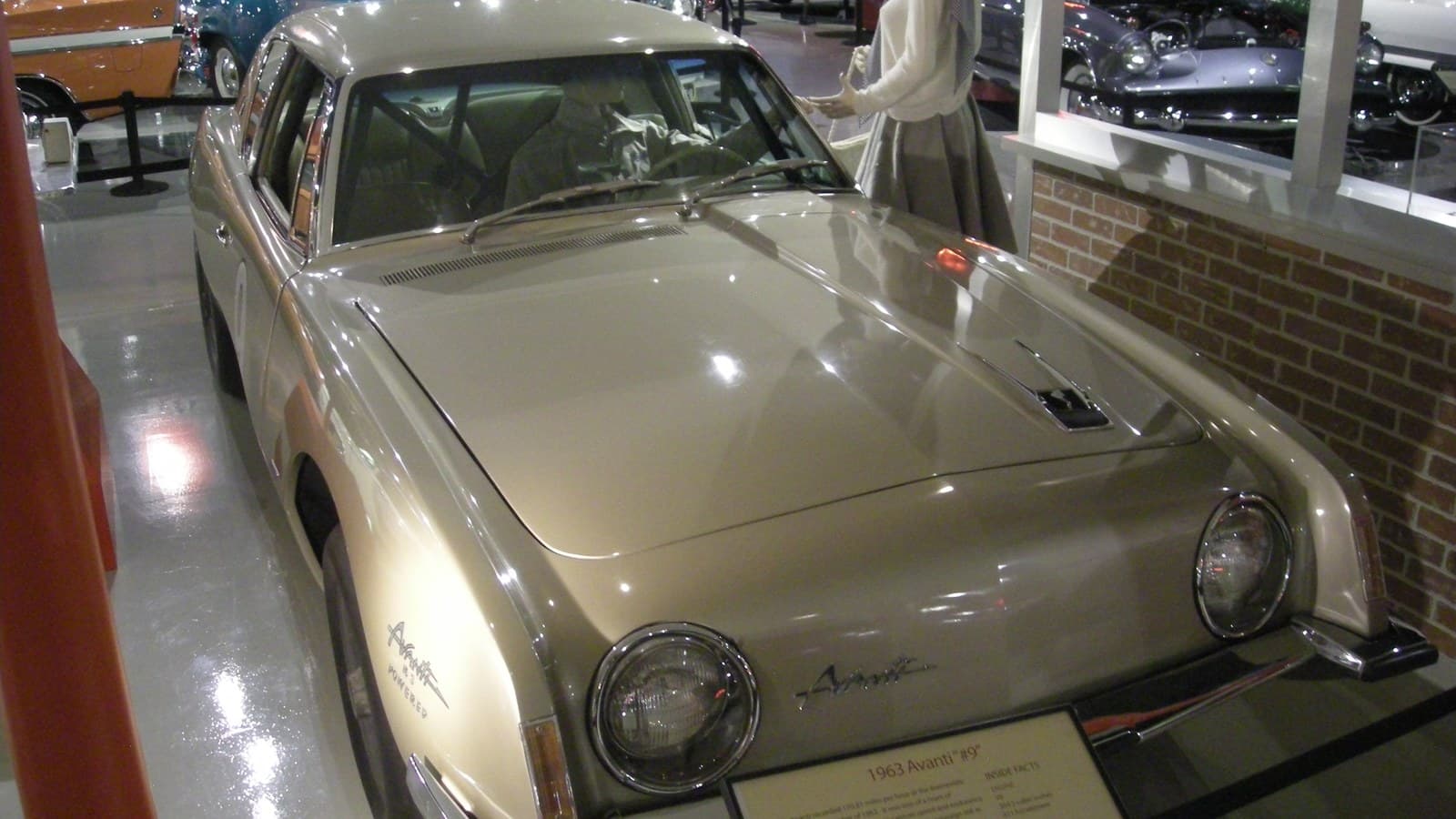
Murphy, 28, averaged 161.29 mph through the flying mile in a production-model Avanti. Studebaker's press office called her "the world's fastest woman on wheels." Joe Granatelli held the groove on the 10-mile circle and broke ten records that had belonged to Mickey Thompson, who had run 155 mph in a Pontiac Catalina. Then Andy took the gold Avanti lettered No. 9 to a Class C mark of 170.8 mph. The Due Cento, its 304.5 V8 fed by two superchargers, ran about 196 mph but never got its 200.
By Granatelli's count in his 1969 autobiography, the 10-day campaign produced 357 speed and endurance records "with never a failure of any kind," as he later put it. He gave credit to STP oil treatment. Studebaker had bought the company that made it. Egbert later put Granatelli in charge of it, and Granatelli said its sales grew from $1.8 million to $105 million. The records sold a lot of oil treatment.
Records sold the car. South Bend couldn't build it.
The salt could sell the Avanti, but the factory could not keep up. The car's 129-piece fiberglass body came from the same Ohio supplier that molded Corvettes, and the early pieces did not fit together. Studebaker had planned to build 1,000 cars a month and managed only a fraction of that. It moved body production in-house, and waiting buyers canceled their deposits.
Avantis were built from June 1962 to December 1963, for a total of 4,643 cars. Of those, 3,834 were titled as 1963 models and 809 as 1964s. On December 9, 1963, Studebaker announced it was closing its South Bend plant. Car production moved to Hamilton, Ontario, and the Avanti did not go with it. The U.S. Department of Labor notes the closing helped drive pension reform: about 7,000 workers got no more than 15 percent of their pension's value.
The shape outlived the company. Two South Bend Studebaker dealers bought the name and tooling and launched the Chevrolet-powered Avanti II in 1965. The No. 9 car, serial R1007, has been displayed at the Studebaker National Museum and at the California Automobile Museum in Sacramento.
Check the story on your own VIN
The No. 9 car carries a Studebaker serial, R1007, not a modern VIN. Your own car's VIN tells its story too, starting with the plant that built it. Run it free at Assembly Alert to see where it was assembled, then check for open safety recalls at nhtsa.gov/recalls.
FAQ
How fast did the Studebaker Avanti go at Bonneville?
In August 1962, Andy Granatelli averaged 168.15 mph both ways through the flying mile in a supercharged Avanti, one of 29 USAC records. In October 1963, he set a Class C mark of 170.8 mph in the gold No. 9 car.
What engine was in the Avanti R3?
A Studebaker V8 bored out to 304.5 cubic inches and fed by a Paxton supercharger at about 6 psi. Studebaker never really announced its output. Hemmings puts factory trim at 335 hp. Only nine Avantis left South Bend with it.
How many original Studebaker Avantis were built?
Studebaker built 4,643 between June 1962 and December 1963, before it announced the closing of its South Bend plant.
Sources
- Classic Motorsports, "Studebaker Avanti: The car that (almost) changed the world" (July 2018 issue)
- Hemmings, "1963-64 Studebaker Avanti"
- Hemmings, "Studependous: 1963 Studebaker Lark R2"
- Hagerty Media, "Before He Finally Conquered Indy, Andy Granatelli Took on Bonneville"
- Motor Trend, "Studebaker-Granatelli Storm Bonneville, 1963"
- Studebaker National Museum, "Studebaker's Last Dance: The Avanti"
- Smithsonian National Museum of American History, Andy Granatelli Collection, "Studebaker at Bonneville" film reel
- U.S. Department of Labor, "Studebaker plant closes"
- Times Colonist, Bill Vance, "The Avanti was Studebaker's brave attempt to save itself"
- Mac's Motor City Garage, "Studebaker Avanti Shatters 29 Records at Bonneville"
- TheAvanti.com, stock racing records and R1007
- NHTSA recalls lookup
The hero photo is a real photograph of the Avanti "No. 9" by Michael Barera, used under CC BY-SA 4.0 via Wikimedia Commons and cropped to 16:9.
Calculators · Facts · Homepage VIN checker · Commercials (18+)