Blog · 2026-10-04
The New REO Runabout Mini Truck: Specs, Price Targets, and Timeline
Free VIN check · US assembly
Free VIN check — was it assembled in the US?
Paste the 17-character VIN. This reads NHTSA PlantCountry. It is a data check, not tax advice, and it does not decide whether any loan is deductible.
Assembly Alert, also prepared for Notice Nearby. Published October 4, 2026. Every figure below is tied to a source in the notes that accompany this piece. If REO has not published a number, the cell says so.
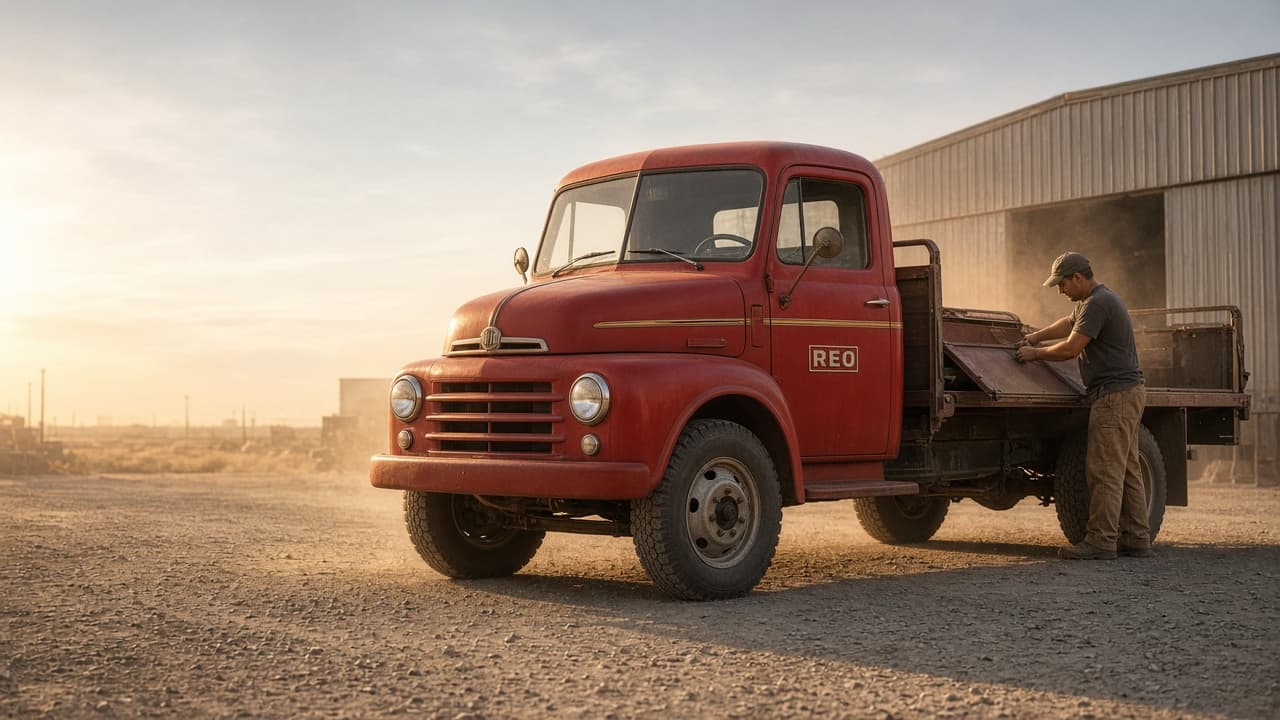
The hero is an original illustration standing in for the planned REO Runabout T4X. It is not a manufacturer photo and not REO’s production design.
There is a hole in the American truck market you can feel with your hands. The honest small pickup, the one that fit in a garage and did not need a seven-year note, left the showroom, and the buyers did not leave with it. Into that hole, in 2026, stepped a Dallas startup with one of the oldest names in the business and a plan that is still a plan: a gas, body-on-frame, mechanically driven four-wheel-drive truck called the Runabout, priced on paper like a truck from a simpler year.
That is the new REO mini truck. It is not a badge on a used Japanese kei truck. It is not a resurrected Speed Wagon. It is not for sale. It is the most serious gas-powered answer yet to the small-truck argument, and it has to be read the way a good shop reads a work order: what is written down, what is still a target, and what nobody has stamped.
What the new REO mini truck actually is
The product is the REO Runabout, from REO Industries, Inc., a Dallas, Texas company led by founder and chief executive Zach De Bernardi. The company says the REO brand returned in 2026. The Runabout is a family of small utility vehicles on one body-on-frame platform: the T4X work truck, the T4C crew cab, and the S4C SUV. REO calls the class an Ameri-Kei. The point of the name, in the company's own letter and in De Bernardi's interview with Road & Track, is a truck inspired by the usefulness of a Japanese kei truck but scaled up for American roads, American garages, and federal motor-vehicle rules.
The truck REO is leading with is the T4X. On the company's site it is a two-door, two-seat work truck with a steel drop-side flatbed and a target starting price of $21,500. De Bernardi told The Drive that T4X stands for truck, four-wheel drive, and bare bones. Road & Track reported that the base truck may arrive without a radio or finished door cards, with comfort added as options rather than baked into the sticker. Screens, the company says, stay scarce: levers, rockers, analog gauges, and one small display for diagnostics and Apple CarPlay. No subscriptions. No feature locks. That is the pitch, in the company's words, not a test we have driven.
Under the brief sits a powertrain choice that separates this project from almost every other new American truck startup of the last decade. REO is not opening with an electric skateboard. The site specifies a naturally aspirated gasoline inline-four, a six-speed manual or a six-speed automatic, and mechanical four-wheel drive. The design goal printed next to that hardware is a powertrain meant to run 500,000 miles. Treat that as an engineering ambition. REO has not published a warranty that says 500,000 miles, and no truck has accumulated them.
The company is selling the idea in the open, on purpose, before the production design exists. Its reserve page says the pictures up now are not production designs and are not even final concept designs. They are directional. A digital reveal is targeted for the fourth quarter of 2026. The first physical vehicle is planned for 2027. Anyone shopping from a render is shopping a mood.
What this truck is not
The phrase "new REO mini truck" can point at three different machines. Only one of them is the current product.
It is not the historic REO, and it is not a new Speed Wagon. Road & Track asked the obvious question and got a plain answer: the company says it holds the Speed Wagon trademark, and it is not using it on the first models. The Runabout name reaches back to Olds's cheap curved-dash car, not to the Lansing hauler. The history is real. The corporate thread is not. More on that below, kept separate so a startup timeline does not get to rewrite a factory town.
It is not a kei truck you import. Japan's current light-vehicle class for a four-wheeler, as published by the Japan Mini Vehicle Association (Zenkoku Keijidosha Kyokai Rengokai), is a maximum of 3.40 meters long, 1.48 meters wide, 2.00 meters high, and 660 cc. The T4X length target is 180 inches, which is 4.57 meters. Width and height targets are 74 inches, about 1.88 meters. That is a different vehicle, in law and in the driver's seat. A 25-year-old Honda Acty or Suzuki Carry already on an American street is a wonderful tool and a different purchase. REO is not rebadging one.
It is not a truck you can register this month. Reservations are open. Orders are not. A July 2026 item on Commute Volt described an REO pickup as launched and available at $21,500. That conflicts with REO's own reserve page, terms, and timeline. This article does not treat that item as a product announcement.
It is not, yet, a certified 2026 or 2027 or 2028 model. No model year has been published. No VIN has been issued. No EPA label, no crash rating, no plant address.
The old REO, told as its own story
Ransom Eli Olds earned the initials. The National Park Service's record of the Reo Motor Car Company plant, and a 2009 MotorTrend history of the Speed Wagon, agree on the shape of the life even where a year slips by a season.
Olds built gasoline cars in the 1890s, formed the Olds Motor Vehicle Company in 1897, and then the Olds Motor Works. The curved-dash Oldsmobile of 1901 sold for $650. The Park Service notes that a fire wrecked almost the whole Detroit factory that year and that Olds still sold 600 cars. He was pushed out of Olds Motor Works in 1904. In August 1904 he organized the R.E. Olds Motor Car Company in Lansing. The name was shortened to Reo to avoid a fight with Olds Motor Works. REO Industries' own timeline says 1905. Both dates describe the same founding: organized in 1904, the name the public remembers set as REO. He held a majority of the stock and the titles of president and general manager.
The truck side started as a division in 1910, the Park Service says. MotorTrend dates the legendary Speed Wagon, sometimes written Speedwagon, to 1915, and calls it the forerunner of the pickup. REO and Road & Track use the same family language: ancestor of the modern pickup. That is a fair reputation. It is not a claim that no one else had ever put a bed behind a cab. By 1925, MotorTrend wrote, more than 125,000 Speed Wagons had been built. The name was later borrowed by the Illinois rock band. The band is a footnote. The truck was the point.
Passenger-car production ended in 1936. Olds resigned as chairman that year and died on August 26, 1950. MotorTrend records a 1938 bankruptcy and a reorganized REO Motors in 1940, then wartime work and, after the war, heavier trucks, including the Army's Eager Beaver. The Park Service says the company was sold to Bohn Aluminum and Brass in 1954. MotorTrend dates that purchase to January 1955. Both accounts put the next sale with White Motor Company in 1957. White combined REO with Diamond T. The Park Service says that merger formed Diamond Reo Trucks, Inc. in 1967. MotorTrend puts the combination in 1966. In 1975, the Park Service says, Diamond Reo filed for bankruptcy and most of its assets were liquidated.
REO Industries' public timeline collapses that arc into one line: REO closes in 1975 after seventy years. The seventy years are the life of the name. They are not seventy years of one unbroken company building the same truck in the same plant. The Lansing Reo plant the Park Service designated a National Historic Landmark was demolished by January 14, 1980. The landmark designation was withdrawn in 1985. There is no mothballed REO line waiting for a switch.
What survived is the name, a museum, a club, and a reputation for trucks that were expected to work. REO Industries thanks the R.E. Olds Foundation, the R.E. Olds Transportation Museum, and the REO Club of America in its September 21, 2026 release. Gratitude is not a deed of succession. The new company is a startup with a historic wordmark and a modern brief.
Three bodies, one frame, three target prices
REO's lineup page, in the script that actually draws the model cards, lists three variants. Prices are the company's targets. The terms page says final pricing arrives when the order book opens.
| Variant | What REO says it is | Seats | Doors | Signature feature | Target start |
|---|---|---|---|---|---|
| Runabout T4X | Work truck | 2 | 2 | Steel drop-side flatbed | $21,500 |
| Runabout T4C | Crew cab | 5 | 4 | Extendable tailgate | $25,000 |
| Runabout S4C | SUV | 6 | 4 | Side-facing jump seat | $28,500 |
Top Gear and Carscoops reported those same three prices in June 2026, including the S4C at $28,500 with side-facing jump seating. The company's letter to the public names only the T4X price out loud and says the T4C and S4C follow on the same frame. The site's own product data now shows all three. Still targets. The homepage hero says "$21,500+" and the reservation terms say there is no final price yet.
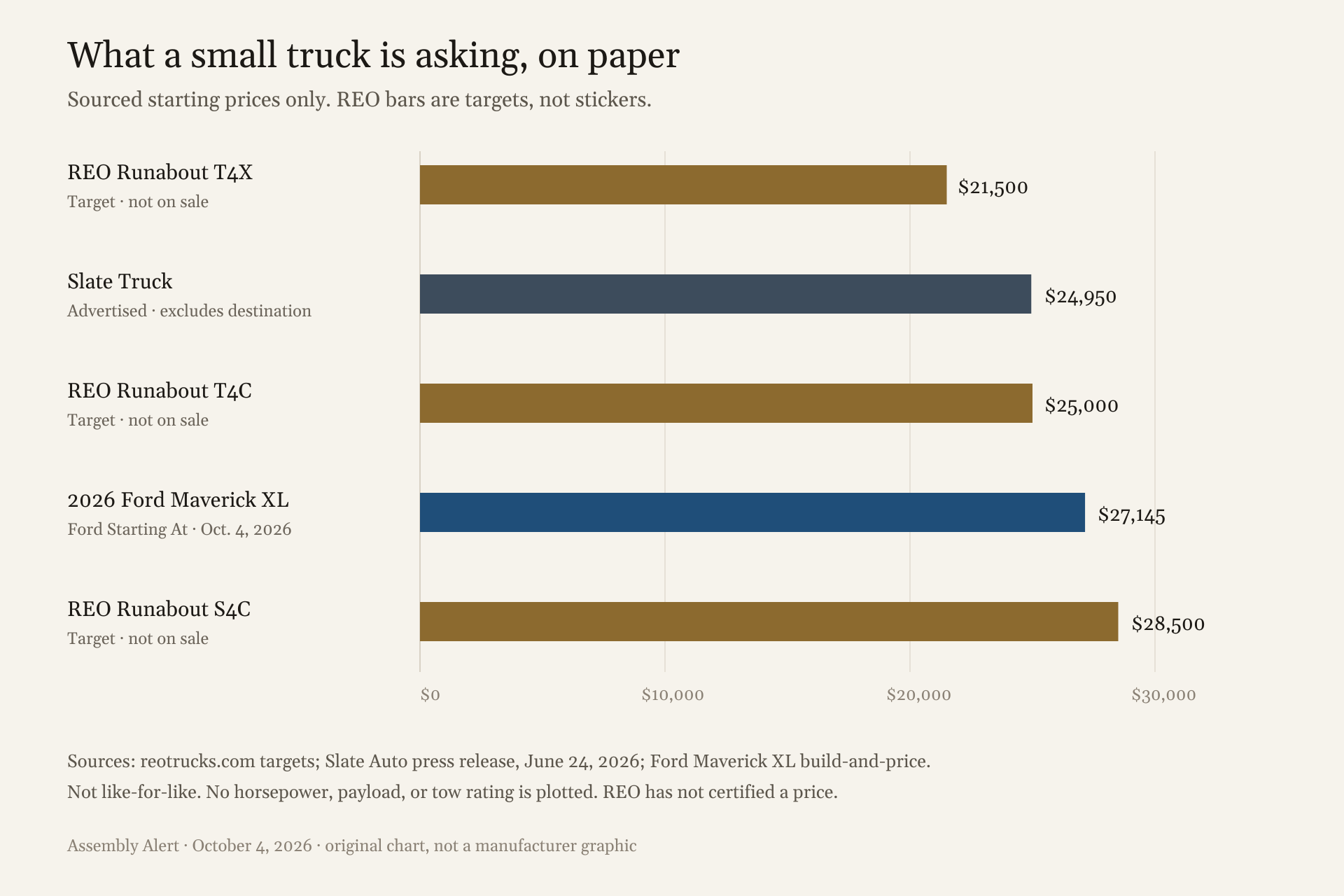
The shared-hardware argument is the part a parts counter will recognize. One frame, one powertrain, one parts bin, three bodies. Fewer unique pieces, in theory, means a cheaper truck to build and a cheaper truck to keep. That is how the compact trucks of the 1980s and 1990s stayed alive in driveways for decades. It is also how a young company tries not to engineer three vehicles when it can barely afford one. REO has not published the parts commonality as a percentage. The idea is published. The proof is not.
The spec sheet, including the zeros you should ignore
REO's homepage has a block labeled "A real truck, by the numbers," and under it a line that matters more than any figure: "Engineering targets · subject to final validation."
If you read the raw page without running its animation, several of those cells say 0. That is a counter starting at zero, not a truck with no payload. The production script served by reotrucks.com on October 4, 2026 sets the targets the counter is built to reach:
| Figure | REO engineering target, Oct. 4, 2026 | What it is not |
|---|---|---|
| Payload | 2,500 lb | Not a certified payload |
| Maximum towing | 4,500 lb | Not a SAE tow rating |
| Length | 180 in | Not a released dimension |
| Width | 74 in | Not a released dimension |
| Height | 74 in | Not a released dimension |
| Fuel economy | ~25 mpg | Not an EPA estimate |
| Curb weight | ~4,200 lb | Not a scale weight |
| Fuel tank | 25 gal | Not a certified capacity |
| Range | ~600 miles per tank | Not an EPA range |
| Powertrain life | 500,000 miles | Not a warranty |
Horsepower: not published. Torque: not published. Displacement: not published. Engine family and supplier: not published. Wheelbase, bed length, bed width, ground clearance, GVWR, axle ratio, tire size, and approach angle: not published.
The static hero, which does not depend on the animation, already shows the architecture in plain text: body-on-frame, mechanical four-wheel drive, gasoline inline-four, six-speed manual or automatic, about 600 miles per tank, a 500,000-mile powertrain life, assembly in Texas, and 4,500 pounds of towing. The naturally aspirated wording is in the reliability section of the same page. Road & Track, in June, called the engine free-breathing and reported that De Bernardi wants it American-built and without direct injection, so it stays simple and can bolt to a manual. Carscoops reported the same no-direct-injection intent. Auto123 described the plan as a yet-unnamed port-injected four and a 25 mpg target. None of those stories names the engine. This article will not guess it. Guessing a GM, Toyota, or Ford four and printing the guess as a spec is how bad truck stories get written.
There is a later, conflicting hint, and it should be labeled as a hint. On July 24, 2026, The Autopian wrote that De Bernardi had challenged readers to identify the T4X engine, and described it as a turbocharged inline-four of about 2 to 2.5 liters making between 260 and 325 horsepower. That description fights the company's own "naturally aspirated" language and Road & Track's "free-breathing" account. Until REO publishes a spec sheet with a supplier and a dyno figure, horsepower stays unpublished. A riddle is not a rating.
The payload number moved
June coverage and the October website do not agree on payload, and pretending they do would be a disservice.
Road & Track (June 22, 2026) reported a length of 180 inches, height and width around 74 inches, and maximum towing set at around 4,500 pounds. Top Gear (June 24, 2026) reported 4.57 meters long and 1.88 meters in both width and height, which is the same 180-by-74-inch box, plus a curb weight around 1,900 kilograms (about 4,190 pounds, in line with the later ~4,200-pound target), a payload around 544 kilograms (about 1,200 pounds), and towing around two metric tons (about 4,400 pounds, a round cousin of the 4,500-pound figure). Auto123 likewise reported a 1,200-pound payload and 4,500 pounds of towing.
By October 4, 2026, the live site still says 4,500 pounds of towing, ~4,200 pounds of curb weight, 180 inches, and 74 inches of width and height. The payload counter is set to 2,500 pounds, not 1,200. REO has not published a note explaining the change. Both figures are targets. A 2,500-pound payload on a truck this short would be a serious rating, closer to a work claim than to a kei truck, and it has not been demonstrated. Use it as what the company is currently advertising as a target. Do not add it to a trailer or a bid.
Length is the dimension that earns the word "mini." Road & Track put 180 inches next to a Honda Civic or a Mazda 3. Carscoops called it slightly shorter than a Mazda 3 sedan. Width and height are the dimensions that take the word back. Seventy-four inches tall and wide is, in Road & Track's phrase, about in line with a mid-size truck on sale today. Short, not tiny. Tall. Wide. A kei truck it is not.
What $21,500 buys today, which is a place in line
Reservations opened with the public launch in June 2026. The price of a reservation is $25, charged to a card, fully refundable, for the United States market only. REO's terms, last updated June 2026, are unusually plain for this kind of project. A reservation is not an order, not a purchase, and not a contract. It does not lock a price or a build date. Positions follow the order in which paid deposits arrive. Cancelled spots are not back-filled. One reservation per person is the intent, and the company says it may cancel duplicates. Refunds go back to the original card, typically in five to ten business days, with no processing fee deducted, any time before a vehicle order is finalized.
The Drive reported 5,500 reservations in six days around the June 24, 2026 launch. REO's September 21, 2026 press release said the company had taken more than 32,500 paid reservations and that the book was still open. That is a real signal that people want this truck to exist. It is not a production rate, a plant, or a balance sheet. De Bernardi told Road & Track that the company is funded and that he has a lot of his own money in it. He did not publish a figure. Road & Track was right to set that next to the recent graveyard of would-be automakers. Sincerity is not a weld fixture.
The roadmap on the site, marked as targets that can change:
- Now: reservations open.
- Fourth quarter of 2026: production design and full lineup revealed.
- 2027: pilot builds, test, and certification to federal standards.
- 2028: order book and configurator. Reservations convert in the order they were placed.
- Late 2028 or 2029: first deliveries, earliest reservations first.
The September 21 release says the same thing in designer language: teasers, then a digital reveal later in 2026, pilot builds in 2027, first deliveries targeted for late 2028 or 2029. As of October 4, 2026, that reveal had not been published in the sources reviewed for this article. The quarter is open. The truck is not.
Sales and service are also unpublished in any operational detail. REO says it will publish the sales, delivery, and service plan before the 2028 order book, and that reservation holders hear first. The letter promises direct sale, no dealers, no markup, and a website price with no hidden fees. That is a distribution plan, not a service map. Where you would buy a water pump in 2031 is not published.
Frank Stephenson, and a design that is still in the detail phase
On September 21, 2026, in Dallas, REO named frankstephenson design as the design partner for all three Runabout models. Frank Stephenson's studio is a serious hire. His four-decade record, as REO stated it, includes the modern MINI, the first BMW X5, the Fiat 500, the Ferrari F430, the Maserati MC12, and the McLaren P1. Those are other people's cars. They are not awards for the Runabout. The Runabout has no awards. It has no production design to award.
De Bernardi said the studio was already in the detail phase of all three variants. Stephenson's quote in the release is the right brief, and it is worth keeping because it matches the hardware story: simple, honest, and built to last. The release also says every Runabout is being drawn around right to repair. A physical switch or lever for every control. Panels and trim off in under five minutes with common tools. No parts-pairing, meaning no component software-locked to the truck. A public parts catalog backed for 20 years.
The same release says each vehicle is engineered to accept future autonomous-driving hardware, with structure and wiring ready so the truck is not cut apart later. The company's letter says it will not bolt beta software onto the truck, and that self-driving waits until it is boring and proven. Read those two sentences together. The platform is being left open. The promise is that nobody has to use the opening. There is no sensor suite, no autonomy supplier, and no autonomy rating published.
Road & Track had been told, back in June, that a final design showing in the fourth quarter of 2026 was on track, and that the company was still reading buyer mail while there was time to change things. That is the right sequence for a truck that does not exist yet. It is also a reminder that the T4X you reserve in October 2026 is not a configured truck. Colors, options, and the configurator come later. REO says so on the reserve page.
How it compares with the trucks people actually cross-shop
REO's own homepage draws a head-to-head against the Ford Maverick and the Slate truck. Some of that table is already stale, and a stale comparison is a bad way to shop. Slate, on REO's graphic, is listed around $25,000-plus, with 150 miles of range, 1,000 pounds of towing, and rear-wheel drive. Slate's own June 24, 2026 press release, and Slate's site as reviewed for this article, tell a newer story: a Blank Slate from $24,950, an estimated 205 miles of range, 2,000 pounds of towing, and 1,550 pounds of payload. The electric truck got more capable while REO's comparison art stood still. The table below uses each company's own pages, not REO's graphic. REO's column is targets. Ford's and Slate's columns are manufacturer figures for products much closer to the road. They are not a road test.
| REO Runabout T4X | 2026 Ford Maverick XL | Slate Truck (Blank Slate) | Japanese kei class (the rule, not one truck) | |
|---|---|---|---|---|
| Status | Pre-production target | On sale | Pre-production; first deliveries expected Q4 2026 | In force in Japan |
| Body | Body-on-frame, drop-side flatbed | Unibody pickup | Electric pickup; MacPherson strut front, De Dion rear axle (Slate estimates) | Class limit, any body |
| Seats | 2 (lineup up to 6) | 5 | 2 as a pickup; five-seat SUV is a different body | Not a vehicle spec |
| Power | Naturally aspirated gas I4; output not published | Standard 2.5L hybrid; available 2.0L EcoBoost rated 250 hp | Single rear motor, 135 kW and 264 Nm, LFP pack | 660 cc maximum |
| Drive | Mechanical 4WD (target) | FWD standard on the hybrid; AWD available. Advanced 4WD is on Lobo and Tremor, not the base XL | Rear-wheel drive | Not specified by the class rule |
| Starting price | $21,500 target | $27,145 starting at, on Ford's build-and-price page for the XL, retrieved Oct. 4, 2026 | $24,950, excluding destination, taxes, and options | Not a new U.S. price |
| Length | 180 in target | Not used here; not pulled from a Ford specs table in this review | 174.6 in | 3.40 m maximum (about 133.9 in) |
| Width | 74 in target | Not used here | 70.6 in without mirrors | 1.48 m maximum (about 58.3 in) |
| Height | 74 in target | Not used here | 68.0 in, pickup | 2.00 m maximum (about 78.7 in) |
| Curb weight | ~4,200 lb target | Not used here | 4,048 lb, pickup, manufacturer estimate | Not published as a class figure |
| Payload | 2,500 lb target (1,200 lb in June reports) | Up to 1,500 lb; hybrid AWD listed at 1,400 lb | 1,550 lb, pickup, manufacturer estimate | Not published here |
| Towing | 4,500 lb target | 2,000 lb standard; 4,000 lb with the available 4K Tow Package | 2,000 lb, pickup, manufacturer estimate | Not published here |
| Range or fuel use | ~600 mi/tank and ~25 mpg, both targets, not EPA | EPA-estimated 42 city / 35 highway / 38 combined mpg, 2.5L hybrid, FWD | 205 mi manufacturer estimate, not an official EPA range | Not applicable |
| Where it is built | Texas, plant city not published | Ford does not assign the Maverick a plant on the pages reviewed here | Warsaw, Indiana, per Slate | Japan, for a kei built to the class |
A few shop-floor readings, and only those.
The Maverick is the truck already in the driveway conversation. It is a unibody hybrid compact pickup with a real EPA label, a real bed (Ford says 4 feet 5 inches, 33.3 cubic feet), five seats, and a price Ford's own configurator put at a $27,145 start for a 2026 XL on the day this article was written. The footnote marker on that price did not come through in the page text we retrieved, so this article does not invent a destination charge and add it on. REO's site rounds the Maverick to "~$28,500." That is REO's comparison number, not Ford's sticker. The Maverick can tow 4,000 pounds only with the 4K Tow Package. Its standard rating is 2,000. It is bigger in mission than a two-seat flatbed, softer in construction if you want a real frame, and it exists. You can go buy one. That is the fact that matters most in a comparison with a paper truck.
Slate is the other startup in the same argument, and it is electric, on purpose. The June 24, 2026 Slate release prices the Blank Slate at $24,950 before destination and options, the Squareback and Fastback SUVs from $29,950, and lists a 65 kWh LFP pack (63 kWh usable), a single rear motor of 135 kW and 264 Nm, a manufacturer-estimated 205 miles, 1,550 pounds of payload, and 2,000 pounds of towing. Slate says the specifications are estimates and the truck is in pre-production. It also names a factory: a reindustrialized plant in Warsaw, Indiana. Slate expects first deliveries in the fourth quarter of 2026. That is years ahead of REO's delivery target, if both companies hit the dates they are printing. De Bernardi told Road & Track he has been watching Slate and wishes it well, and that what he hears from buyers is a wish for a diesel or a small four-cylinder. His whole company is that sentence.
The kei column is there because it is the other thing people mean when they type "mini truck." The class limits are the sourced comparison. A kei truck is narrower than a full-size truck's tailgate is tall. The Runabout's width target is more than a foot beyond the kei maximum. Payload, price, and safety rules do not transfer from one to the other. If you need a truck this month for farm lanes and short hauls, the used kei is the truck that exists. If you want a new, warrantied, federally certified American gas truck in that spirit, nobody is handing you the keys in 2026. That is the market REO is trying to open.
What REO is promising, and what neither comparison truck quite is: a short body-on-frame gas truck with a manual in the order guide and a mechanical transfer case, aimed under the Maverick's advertised start. What REO is not promising with evidence: that $21,500 survives contact with crash rules, emissions rules, a real supplier quote, and a Texas payroll. De Bernardi has said, to Road & Track and to The Drive, that the easing of fuel-economy pressure in late 2025 is what made the project feel possible, and that a political reversal could push the company toward a hybrid still burning gasoline. He also said, in the public letter, that other powertrains wait until the law and the supply chain change, and that waiting is the strategy, because late adoption buys proven parts. Hold him to the published truck. The published truck is the gas four.
Right to repair, said in shop language
The ownership pitch is the part of this story that sounds like a person who has actually turned a wrench.
REO says every control is a switch or a lever. The only screen is a small one, for diagnostics and CarPlay. Diagnostics are supposed to read in plain English on a $30 scanner. Bumpers, door cards, headliner, and trim are supposed to come off in under five minutes with common tools. There is no parts-pairing: nothing on the truck, the company says, checks where a part came from. The parts catalog is supposed to be public, fairly priced, and backed for twenty years. On top of that, an authorized maker program would let vetted outside makers sell parts on REO's own marketplace, at fees the company says will undercut eBay, RockAuto, and Amazon. An owners' club, run by the factory, is supposed to live in the same place.
De Bernardi told The Drive the design briefs are being written around "reliability by design," with examples a Toyota person will recognize: do not make someone pull the interior to reach a fuel pump, and put the intake where a snorkel wants to live. He also described, as a counter-example, the specialty tools needed to pull the vents and the head unit in his own Audi. That is a real complaint. It is not yet a REO service manual.
None of this is a statute, and none of it is a truck you can stand under. "Open source," in REO's usage, means the vehicle does not lock parts to a VIN and that patterns will be shared with approved makers. It does not mean a GitHub repository of frame drawings was published for this article. No such repository was found in the sources reviewed. The 20-year catalog is a promise from a company that has not yet shipped a part. Promises like that are worth printing, because buyers should be able to quote them later.
Plant country, a VIN, and the loan-interest test
The Runabout is aimed at the road. REO's 2027 step is pilot trucks "tested and certified to federal standards." That is the language of a motor vehicle, not a side-by-side with a whip antenna and a plate that says off-highway only. When trucks like that are built, each one gets a 17-character VIN. None exists today. There is nothing to decode.
When there is a VIN, here is the part people get wrong, and the part that matters if you are asking whether interest on the loan could be deductible under the One Big Beautiful Bill Act's car-loan provision.
The first character of a VIN is not the country of the assembly plant. It is the start of the world manufacturer identifier, a region code for who built the brand's number, not a stamp of which factory gate the truck rolled out of. Plant country is a fact about a specific factory. You get to it by reading the VIN's plant code, the 11th character, identifying that plant, and then identifying the country of that plant. A truck can wear an American name and be screwed together somewhere else. A truck can be screwed together in the United States by a company whose world manufacturer code looks, at a glance, like someplace else. The plant decides.
Assembly Alert checks that plant country for free at the free homepage VIN checker. You can also paste the VIN in the free checker on this page. The checker wants the full 17-character VIN. In that plant test, a result of UNITED STATES or USA passes. Puerto Rico does not pass. Texas would be in the United States if, and only if, the VIN of the truck you bought decodes to a plant in Texas. "Built in Texas" on a homepage is not that decode. A target is not a deduction. A reservation is not a loan.
This is not tax advice. Plant country is one test. The deduction has others: what counts as a qualified vehicle, how the loan is written, how the truck is used, price limits, and whatever the statute requires in the year you file. A mini truck does not qualify because it is small, because the badge is old, or because the founder hopes to assemble it in Texas. If your truck is a used kei import, or an off-road machine that never received a 17-character road VIN, do not pretend the deduction comes with the bed. You can still learn the plant country of a vehicle that has a VIN. You cannot manufacture a U.S. assembly point the VIN does not support.
Slate, for comparison, has named Warsaw, Indiana. That is a U.S. city, and it is still not your deduction. Your truck's VIN is the document. Ford's Maverick plant is not settled in the pages this article used, so this article does not assign one. Run the VIN.
The sober version of a proud idea
The brief is the one American truck people describe in diners. Short enough. Gas. A frame. A lever for four-wheel drive. A manual if you want it. Fixable with tools you already own. Priced so the loan is not the longest relationship of your life. REO has written that brief in public, hired a designer who has revived famous names before, and talked a large number of people into a $25 refundable place in line. More than 32,500 of them, as of September 21, 2026.
The brief is not the truck. The truck is a naturally aspirated four that has not been named, a 180-inch body that has not been crashed, a 4,500-pound tow figure that has not been tested, a payload target that has already moved by more than a thousand pounds in print, and a Texas factory that has no published city. First deliveries, if the roadmap holds, are late 2028 or 2029. Between now and then the company has to design the vehicle, pick the suppliers De Bernardi will not name, certify it, and build it at a price that has embarrassed larger companies.
That is not a reason to sneer. It is a reason to keep the name and the plan in separate hands. The old REO earned its reputation in Lansing with steel that went to work. The new REO earns the right to that word one published spec at a time. Until the reveal, the honest American thing to do with a REO Runabout is to know exactly what you were promised, and exactly what you were not.
Frequently asked questions
What is the new REO mini truck?
The new REO mini truck is the Runabout, a planned lineup from REO Industries, Inc., a Dallas company that brought the REO name back in 2026. The lead model is the Runabout T4X, a two-door, two-seat work truck with a steel drop-side flatbed. It is a pre-production program. REO is taking refundable reservations. It is not delivering trucks.
How much will a REO Runabout cost?
REO's website shows target starting prices of $21,500 for the T4X, $25,000 for the T4C crew cab, and $28,500 for the S4C SUV. The reservation terms say any price on the site is an estimate for a vehicle still in development and may change. There is no final price, no window sticker, and no destination charge published as a separate line.
When can I buy a REO Runabout?
Not in 2026. REO's target roadmap, repeated on its site and in its September 21, 2026 design announcement, is a model reveal in the fourth quarter of 2026, pilot builds and validation in 2027, an order book and configurator in 2028, and first deliveries in late 2028 or 2029. The company says those dates can move. A reservation is not a delivery slot you can schedule.
Is the new REO company the same one that built the Speed Wagon?
No. The historic firm was Ransom Eli Olds's REO Motor Car Company in Lansing, Michigan, later merged into Diamond Reo, which the National Park Service records as filing for bankruptcy in 1975. REO Industries, Inc. is a 2026 startup using the name. It has no Lansing factory and no corporate continuity with the old truck line. The first planned product is a Runabout, not a new Speed Wagon.
Is the REO Runabout a kei truck I can import?
No. REO calls the idea an Ameri-Kei: inspired by Japanese kei trucks, sized for American roads, and aimed at federal certification. Japan's current four-wheel kei class, published by the Japan Mini Vehicle Association, caps length at 3.40 meters, width at 1.48 meters, height at 2.00 meters, and engine size at 660 cc. REO's T4X length target is 180 inches, about 4.57 meters. A used kei truck already in the United States is a different, much smaller vehicle.
Does the REO Runabout have a manual transmission and four-wheel drive?
That is the published plan. REO's site lists mechanical four-wheel drive and a six-speed manual or a six-speed automatic, with a naturally aspirated gasoline inline-four. Horsepower, torque, displacement, and the engine supplier are not published. One June 2026 Carscoops story said the truck would be paired exclusively with a manual. The company's own site lists both a manual and an automatic, and that is the figure this article uses.
What are the payload, towing, and fuel-economy numbers?
On October 4, 2026, REO's website lists engineering targets of about 2,500 pounds of payload, 4,500 pounds of maximum towing, about 25 mpg, about 4,200 pounds of curb weight, a 25-gallon fuel tank, and about 600 miles per tank. The same page says those figures are subject to final validation. In June 2026, Top Gear reported an earlier payload of about 544 kilograms, roughly 1,200 pounds. Neither number is a certified rating, and REO has published no EPA figure.
Where will the REO truck be built, and what model year is it?
REO says the trucks will be assembled in Texas. It has not published a plant city, a site plan, or a model year. The company is based in Dallas. Calling it a 2026 model would invent a model year the company has not assigned. The 2026 date is the year the brand returned and opened reservations.
Is the $25 REO reservation a down payment on a truck?
No. REO's reservation terms, last updated June 2026, say the $25 is fully refundable, holds a place in line, and is not an order or a contract to buy. It does not guarantee delivery, price, specifications, options, or timing. Current reservations are for the United States market only. Cancel before you finalize an order and the company says the full $25 goes back to the original card.
Will a REO Runabout qualify for the car-loan interest deduction?
Not automatically, and not today. No production truck exists, so no 17-character VIN exists to check. A sentence on a website that says built in Texas is not a plant code. When a VIN does exist, the assembly-plant country is not the first digit. That first character marks the manufacturer's region. Plant country comes from the factory that built that vehicle. Assembly Alert's free homepage VIN checker treats a plant country of UNITED STATES or USA as passing the OBBBA car-loan interest plant test. A plant in Puerto Rico does not pass that test. Other tests in the law still apply. This is not tax advice, and a mini truck does not qualify just because it is small or wears an American name.
A note on sources
Figures in this article were checked against REO Industries' own site (the public pages and the production script that fills the spec counters), REO's September 21, 2026 design release, Road & Track, Top Gear, Carscoops, The Drive, The Autopian, the National Park Service, MotorTrend, the Japan Mini Vehicle Association's standards table, Ford's 2026 Maverick pages including the XL build-and-price configurator, and Slate Auto's June 24, 2026 press release and public site. Retrieval date for the live pages: October 4, 2026. The figures were checked against these published pages. If a number is not on those pages, it is not a number this article is willing to use.
- REO trucks homepage
- REO reserve
- REO terms
- REO frankstephenson design release
- REO the case
- Road & Track
- Top Gear
- Carscoops
- The Drive
- The Autopian
- Auto123
- National Park Service, Reo Motor Car Company plant
- MotorTrend Speed Wagon history
- Japan Mini Vehicle Association standards
- Ford Maverick
- 2026 Maverick XL build-and-price
- Slate June 24, 2026 press release
- Slate
- Plant-country check: free homepage VIN checker
AssemblyAlert is not tax advice and is not affiliated with the IRS, NHTSA, REO, Ford, or Slate. Owned by Record of Sale, LLC. This site never says a loan is deductible and never says a reader qualifies.
Nothing here is an offer to sell a vehicle, a reservation, or a loan. Nothing here is tax, legal, or financial advice.
Calculators · Facts · Homepage VIN checker · Commercials (18+)